How atmospheric water generation, local entrepreneurship and community partnerships are opening new possibilities for water security in one of Kenya's most water-stressed settings.
In a place where access to reliable drinking water can shape the rhythm of everyday life, finding new ways to make water available is about more than technology. It is about dignity, opportunity and building systems that respond to the realities of the people who depend on them.
In Kakuma Refugee Camp in Turkana County, northwestern Kenya, water security remains an important challenge for refugee and host communities. The area's arid climate and pressure on existing water resources make reliable access to safe drinking water a continuing priority.
For communities facing these challenges, the question is not simply where water can be found. It is how it can be made available more reliably, affordably and closer to the people who need it.
At Majik Water Technologies, a Kenyan women-led organisation developing atmospheric water generation solutions, we believe innovation has an important role to play in answering that question.
Our work in Kakuma demonstrates how technology and local partnerships can come together to explore a different approach to community water access.
Turning atmospheric moisture into drinking water
One of the most promising aspects of atmospheric water generation is its ability to use a resource that is already present in the environment: moisture in the air.
Majik Water's atmospheric water generators work on a principle similar to a dehumidifier. They draw in surrounding air and cool it below its dew point, causing moisture to condense into liquid water.
The collected water then passes through a treatment process that includes reverse osmosis filtration and remineralisation. This helps produce water intended for drinking.
The process can be supported by solar energy, making it possible to explore water production in locations where conventional infrastructure and reliable electricity may be limited.
Of course, atmospheric water generation is not a universal replacement for boreholes, piped water systems or other established sources. Its performance depends on environmental conditions, including humidity, temperature and the energy available to operate the equipment.
However, it offers an additional option for diversifying water supplies, particularly when systems are appropriately designed for the conditions in which they will operate.
A 500-litre-per-day system, rooted in a local partnership
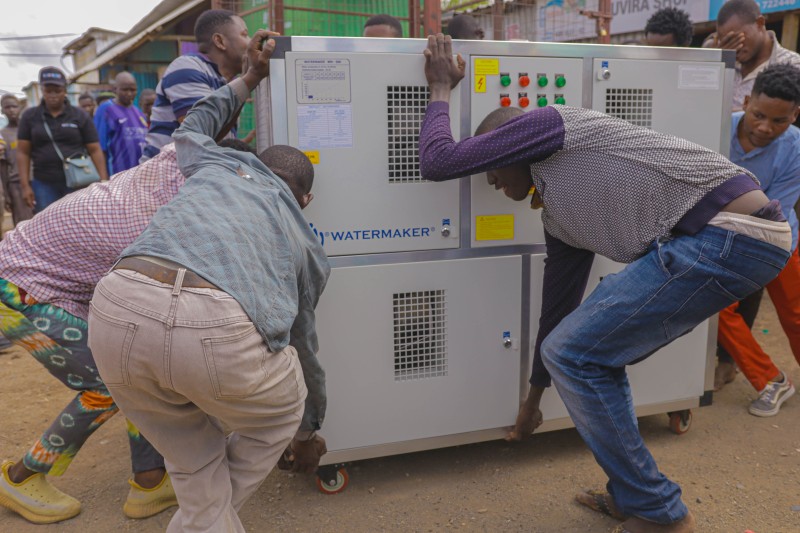
In Kakuma, Majik Water installed an atmospheric water generator with a rated production capacity of 500 litres per day within a kiosk operated by a member of the refugee community.
This decision is an important part of the project's approach.
Rather than establishing a completely separate distribution point, the technology was integrated into an existing local enterprise. The refugee entrepreneur became a partner in bringing the water solution closer to the community.
The kiosk provides a point where people can access drinking water at a lower price.
Through this initiative, Majik Water reports reaching more than 600 people in the community.
The model illustrates an important principle: technology can become more meaningful when it is connected to the people and structures already present in the communities it is intended to serve.
A water generator may have the technical capacity to produce hundreds of litres, but that capacity alone does not guarantee access. Distribution, affordability, local participation and the practical realities of operating a water point all matter.
By working with a refugee entrepreneur, Majik Water is exploring a community-centred approach in which local participation is part of the solution rather than an afterthought.
Why affordability and local participation matter
Water security is not only about the physical availability of water. It is also about whether people can access it when they need it and at a price they can afford.
For households managing limited resources, the cost of drinking water can place additional pressure on already stretched budgets. Making water available at a lower price can help reduce that barrier.
The kiosk model also highlights the importance of local entrepreneurship in community-based water solutions.
Refugees are often described primarily through the challenges they face. Yet refugee communities also have people with skills, ideas, businesses and the ability to participate in building solutions.
Partnering with a refugee entrepreneur recognises that potential.
It creates an opportunity to connect water technology with an existing local business and places a community member at the centre of how the solution reaches people.
This is particularly important when considering the long-term sustainability of water initiatives. A technology installation needs more than an initial investment. It needs an operating arrangement, people who understand the local context and a practical way of reaching its intended users.
Community participation can help build that connection.
Climate resilience requires more than one solution
Climate change is placing increasing pressure on water resources in many parts of the world. In arid and semi-arid regions, changing rainfall patterns, high temperatures and prolonged dry periods can make already difficult water-access conditions even more challenging.
Building resilience therefore requires a combination of approaches.
Solar-powered atmospheric water generation offers one possibility: producing water closer to where it is needed, rather than relying exclusively on distant sources and transportation.
Where atmospheric conditions are suitable, decentralised production may also reduce dependence on water trucking. This could bring environmental benefits by reducing some water-transport journeys and their associated emissions. However, the actual savings depend on the energy used by the generator, its operating performance and the transport arrangements it replaces.
For Majik Water, this is part of a broader commitment to exploring solutions that connect water security with clean energy and climate action.
It also reflects the importance of the United Nations Sustainable Development Goals, particularly:
- SDG 6 – Clean Water and Sanitation: Expanding opportunities for access to safe and affordable drinking water.
- SDG 7 – Affordable and Clean Energy: Exploring renewable energy to support decentralised water production.
- SDG 13 – Climate Action: Strengthening community resilience through approaches adapted to environmental challenges.
There is also potential for decentralised water systems to support other community activities, including small-scale food production where water availability, quality and operational requirements make this feasible. Such opportunities require careful planning rather than assuming that drinking-water systems can automatically support every other use.
Building water solutions with communities, not just for them
The Kakuma project reinforces a lesson that is central to Majik Water's approach: meaningful innovation must consider the people who will use and depend on it.
Technology matters. Production capacity matters. Water treatment matters. But so do affordability, local partnerships, distribution and the ability to maintain a system over time.
A 500-litre-per-day atmospheric water generator is one component of a wider solution. Its value is shaped by how effectively it connects with the needs of the community.
The partnership with a refugee entrepreneur demonstrates why local participation deserves to be part of conversations about climate innovation and water security.
As water challenges become more complex, there is a growing need to explore solutions that are adaptable, decentralised and responsive to local realities. No single technology will solve water scarcity everywhere. But combining appropriate technologies with community knowledge and local enterprise can help create more options for communities facing water insecurity.
At Majik Water Technologies, we believe the future of water security must involve more than finding new sources of water. It must also involve rethinking how water is generated, distributed and made accessible.
The work in Kakuma is one example of that commitment.
Because the future of water security should not only be about bringing water to communities. It should also be about building solutions with the communities themselves.
Be part of the conversation
Discover how Majik Water Technologies is using atmospheric water generation to explore new possibilities for decentralised water access and climate resilience.
Learn more about our work, technology and community partnerships at majikwater.africa.
<